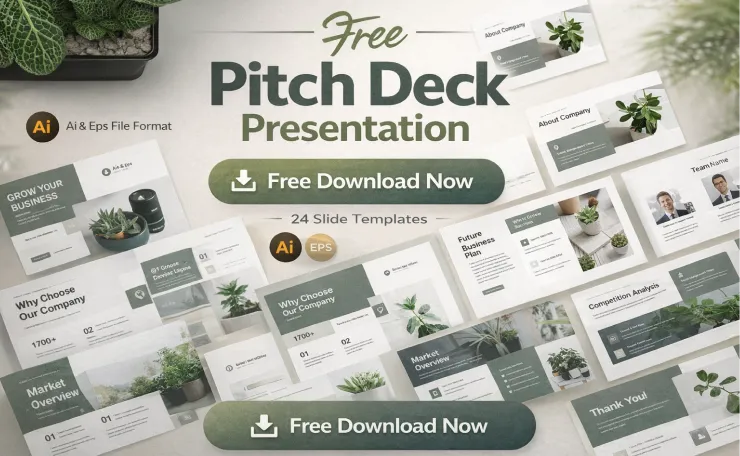
If you’re building a SaaS product and planning to raise money (or even sell to bigger customers), your pitch deck presentation is not a “nice-to-have.” It’s the fastest way to make someone understand your product, your market, and why your team is the one that should win.
But here’s the problem: most pitch decks are either beautiful but empty… or informative but painful. Investors and buyers accept decks because the idea is bad. They reject decks because the story is unclear, the positioning is weak, and the slides feel like homework.
This guide walks you through a modern SaaS pitch deck presentation—slide by slide—with examples, best practices, and a simple checklist you can use right away.
What Makes a SaaS Pitch Deck Different?
SaaS is not like eCommerce, marketplaces, or consumer apps. Investors (and enterprise buyers) care about specific SaaS signals:
- Retention (do users stick?)
- Growth efficiency (do you grow without burning cash forever?)
- Unit economics (is the model profitable at scale?)
- Expansion (can customers grow within the product?)
- Competitive moats (why you, why now, why this approach?)
A strong investor pitch deck doesn’t just show your product. It shows your business engine.
Notion Presentation Templates: Create Slide-Ready Presentations Faster
The Ideal SaaS Pitch Deck Length
For most SaaS founders:
- 10–14 slides is the sweet spot for a first meeting
- 15–18 slides if you’re including deeper traction + metrics
- Anything above that becomes a “document,” not a presentation
The goal is simple: make the next step obvious (a partner meeting, diligence, or a second call).
Free Download
The Slide-by-Slide SaaS Pitch Deck Presentation Framework
1) Cover Slide
Purpose: Identify what you do in 5 seconds.
Include:
- Company name + logo
- One-line value proposition (not a slogan)
- Presenter name + title
- Website
Strong example formula:
“We help [target user] achieve [outcome] without [pain].”
2) The Problem
Purpose: Prove this problem is real and expensive.
Avoid generic claims like “teams struggle with productivity.” That’s everybody. Instead, write like you interviewed 20 customers.
Do:
- 2–4 crisp problem bullets
- Real-world scenario (1 short paragraph max)
- Optional: one proof point (stat, cost, time loss)
Tip: If your problem statement could fit any startup, it’s not sharp enough.
3) The Current Alternatives
Purpose: Make people feel the friction of “how it’s done today.”
This slide increases urgency. It also sets you up to look inevitable.
Common “today” alternatives in SaaS:
- Spreadsheets + manual processes
- 3–5 tools stitched together
- Legacy enterprise software
- Agency/contractor dependency
4) The Solution
Purpose: Explain the product outcome, not every feature.
Best format:
- 1 headline outcome
- 3 supporting benefits
- 1 product screenshot (clean, annotated lightly)
Avoid: a crowded collage of UI screens.
Do: one core screen that tells the story.
Free Download
5) Product Demo Snapshot
Purpose: Help them visualize usage quickly.
Structure:
- Input (what the user does)
- Magic (what your product automates)
- Output (what the user gets)
This slide is gold for SaaS because it compresses complexity.
6) Why Now
Purpose: Answer why this opportunity is happening right now.
Examples of credible “why now” angles:
- A platform shift (AI, API ecosystems, security rules)
- Regulation changes
- New buyer behavior (remote work, privacy)
- Tech costs dropped (compute, LLMs, infra)
- Market maturing (category creation moment)
7) Market
Purpose: Prove the market is big and reachable.
Skip the “$200B TAM” slide that feels disconnected from reality.
Better approach:
- Start with ICP (ideal customer profile)
- Estimate the serviceable market you can actually reach
- Show first 1–2 segments you’re targeting
If you sell to multiple audiences, pick your first wedge and commit.
8) Business Model
Purpose: Show how you make money and how it scales.
Include:
- Pricing tiers (or average contract value)
- How customers upgrade (usage, seats, add-ons)
- Typical sales motion (self-serve, sales-led, hybrid)
- Optional: gross margin range (if you’re sharing)
9) Traction
Purpose: Prove demand and execution.
Traction slides fail when they include vague lines like “Growing fast!” with no context.
Great traction includes:
- Revenue trend (MRR/ARR) or pipeline for early-stage
- Retention signal (cohorts, churn, repeat usage)
- Adoption signal (activation, engagement)
- Logos (only if credible; early-stage is okay without them)
Rule: One chart > ten numbers.
Free Download
10) Go-To-Market
Purpose: Show how you acquire customers consistently.
Pick one primary channel and one secondary—don’t list ten.
Examples:
- SEO + content (inbound)
- Partnerships (platform ecosystems)
- Outbound (ICP-specific lists + sequences)
- Paid acquisition (only if unit economics make sense)
- Community-led growth
Include:
- Target buyer
- Channel
- Conversion path (lead → demo → close)
- What’s working now (even small signals)
11) Competitive Landscape
Purpose: Show you understand the space—and why you win.
Avoid “we have no competitors.” That’s a red flag.
Better:
- Competitor grid with 4–6 players
- Differentiate by positioning and approach
- Highlight your unique advantage (data, workflow, speed, cost, integration, distribution)
12) Team
Purpose: Reduce risk.
Include:
- Relevant domain expertise
- Execution history (shipped products, scaled teams)
- Credibility signals (ex-company, open-source, industry network)
No need for life stories. Just: why this team can pull it off.
13) The Ask
Purpose: Tell them what you want and what it unlocks.
Include:
- Round target (e.g., $1.5M seed)
- Runway (e.g., 18 months)
- Use of funds (3–4 bullets: product, GTM, hires)
- Milestones you’ll hit (what success looks like)
Make the next step simple:
“If this is interesting, we’d love a 30-min partner meeting next week.”
Pitch Deck Design Tips That Instantly Make You Look More Fundable
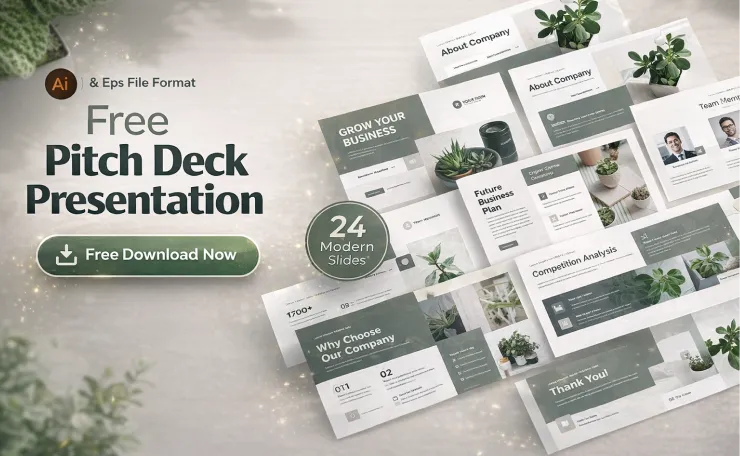
A clean deck feels like a company that ships.
Do this:
- One idea per slide
- Big typography (headlines should be readable on Zoom)
- Consistent spacing + grid
- Minimal animations
- Real product screenshots (not random UI mockups)
- Use 2 fonts max and a tight color palette
Avoid this:
- Paragraph blocks
- Tiny charts
- Over-styled gradients and heavy shadows
- “Clipart icon overload”
- Unreadable light-gray text
If you want a simple rule: your deck should feel like a premium SaaS landing page.
Common Mistakes That Kill a SaaS Pitch Deck Presentation
- Too much “what,” not enough “why.”
- No clear ICP (you’re for “everyone”).
- Feature dumping (investors care about outcomes).
- Weak positioning (no reason to choose you).
- Traction slide without context.
- Confusing metrics (too much, too early).
- No clear ask (what do you want them to do next?).
Free Download
A Quick SaaS Pitch Deck Checklist
Before you send your deck, check:
- Can someone explain what you do after the first 2 slides?
- Is the problem specific and painful?
- Do you show the “today” alternative clearly?
- Does your solution feel simple and inevitable?
- Is your traction measurable and easy to read?
- Is GTM focused and believable?
- Is your differentiation clear in 10 seconds?
- Is the ask specific to milestones?
- Does the design feel clean and consistent?
FAQs
What is a SaaS pitch deck presentation?
A SaaS pitch deck presentation is a short set of slides that explains your software business—problem, solution, market, traction, business model, and funding ask—designed to secure investment or enterprise buyers.
How many slides should a SaaS pitch deck be?
Most successful decks are 10–14 slides for first meetings. Add more only when you have strong traction metrics or need deeper GTM clarity.
What should be included in an investor pitch deck for SaaS?
At minimum: problem, solution, product demo snapshot, why now, market, business model, traction, GTM, competition, team, and ask.
Should I use a pitch deck template?
A pitch deck template is fine for structure, but the content must be original. Templates help layout, not strategy. Investors fund clarity, not design tricks.



Leave a Comment